Weighing a galaxy
with light
A ring in the sky. A line of algebra.
And a lot of missing mass.
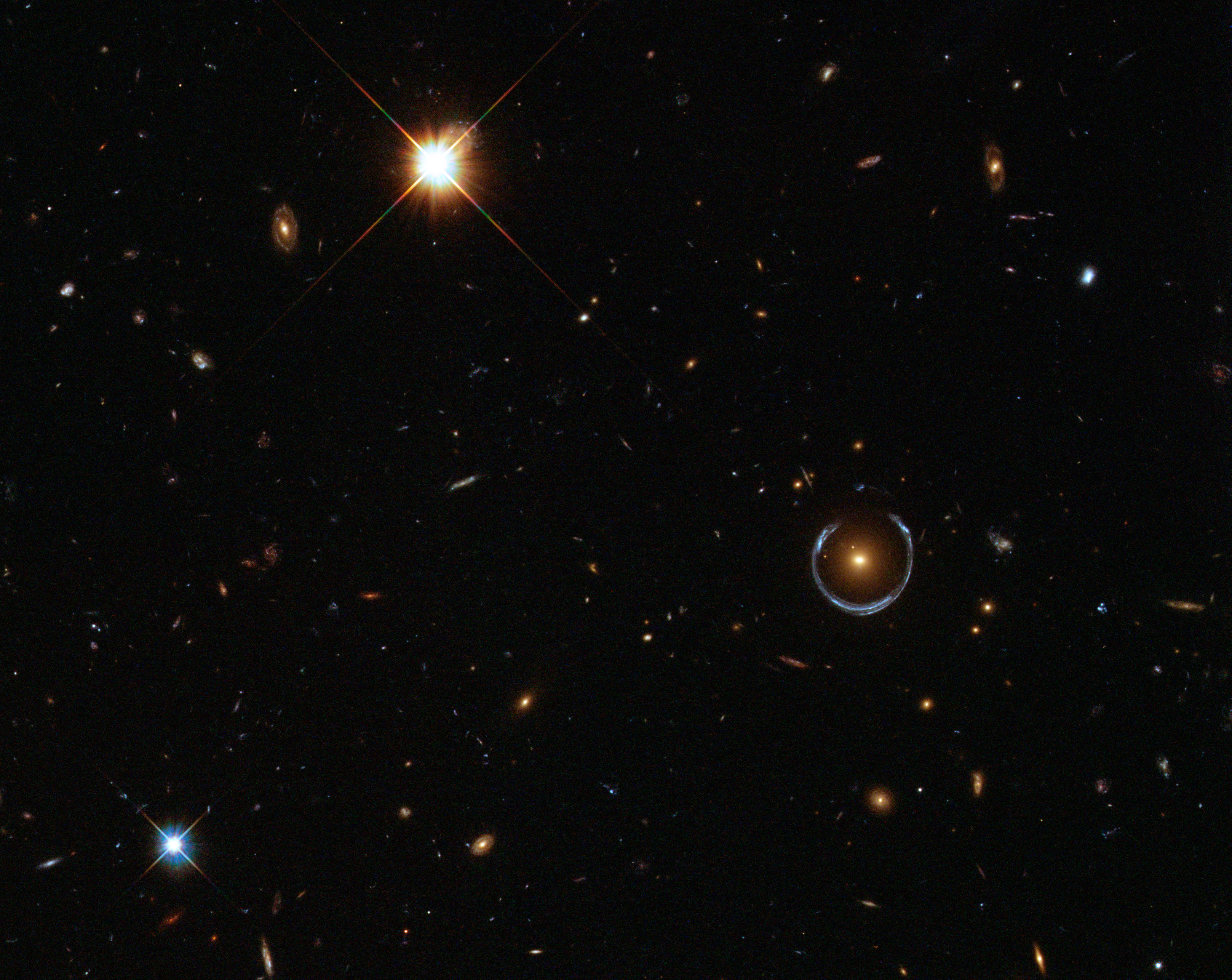
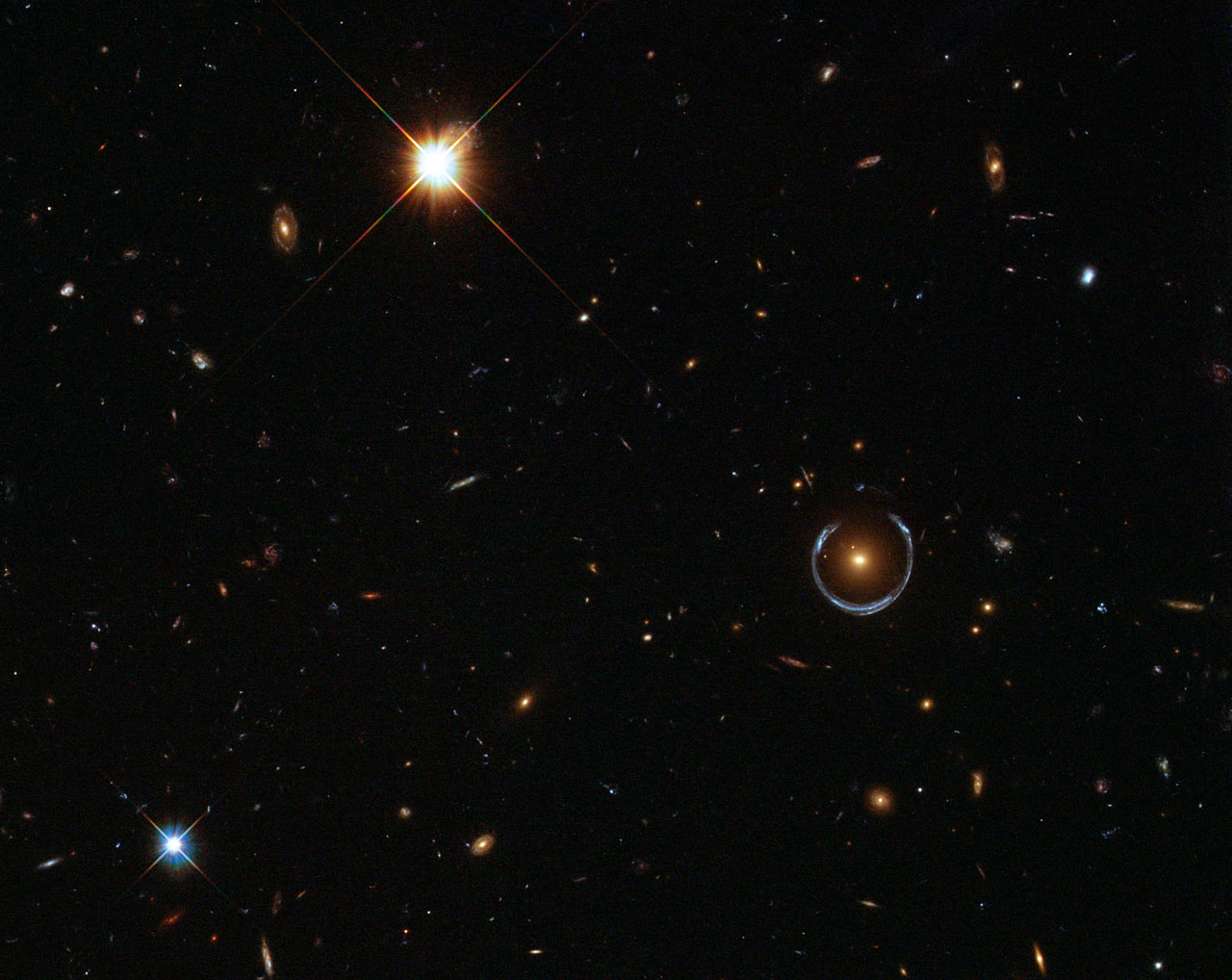
The gold center is the lens galaxy. The blue horseshoe is a more distant galaxy whose light bends around it.
Cosmic HorseshoeMass bends light
More mass bends it more. Passing farther away bends it less.
Try doubling mass, then doubling distance.
A whole circle of paths reaches us
When source, lens and telescope line up, we see an Einstein ring.
ESA/Hubble & NASA
Light that lands on Earth.
Blue pathsLight that misses us.
Drag the scene to rotate. Slide to zero mass to straighten the rays.
Illustrative geometry. Bending exaggerated. Ring radius scales with √mass.
Four times the mass. Twice the radius.
The ring grows with the square root of mass.
Source and lens distances stay fixed.
The Cosmic Horseshoe
A real ring around SDSS J1148+1930, discovered in 2007.

″ means arcseconds: 1/3,600 of a degree. A 5″ radius makes a 10″ diameter.
Belokurov et al. 2007Redshift gives us the geometry
Expansion stretches light. A cosmology converts that stretch into distances.
Lens redshift stays at 0.444. Mpc means megaparsec, about 3.26 million light-years.
Angular-diameter distances. Dls ≠ Ds − Dl. Diagram not to scale.
The ring becomes a weighing scale
We measure the radius. Then solve the equation for mass.
About five trillion Suns inside the ring
The real inputs, with every multiplication visible.
Detailed published model: 5.02 ± 0.09 trillion Suns
Dye et al. 2008
The stars predict a smaller ring
Starlight estimates how much mass belongs to stars.
Real Hubble photograph · ESA/Hubble & NASA. Rings are illustrative model overlays.
Simplified enclosed-mass comparison. A full prediction also needs the stars’ radial distribution. The two percentages represent different stellar-population models.
Spiniello et al. 2011Most of the gravitating mass is unseen
The light accounts for only part of what gravity weighs.
Real Hubble photograph · ESA/Hubble & NASA. Rings are illustrative model overlays.
Gold: stars (17%) · Blue: additional mass · Outline: lensing total
Dark matter is the standard explanation. Lensing weighs total mass; it does not identify a particle.
Could a small measuring error close the gap?
Change the radius while keeping the geometry and stellar estimate fixed.
Real Hubble photograph · ESA/Hubble & NASA. Rings are illustrative model overlays.
A sensitivity experiment, not the published uncertainty or a test of every systematic effect.
Even simulations face a lensing puzzle
A different comparison: observed cluster lenses versus dark-matter simulations.

Lensing probability, normalized
The 2020 study found >10× the predicted efficiency of small galaxy lenses inside 11 clusters.
This is a probability comparison, not a 10× bend angle. Historical result; interpretation depends on the models.
Meneghetti et al. 2020Light lets us weigh what we cannot see
A measured ring gives total mass. Starlight gives the stars’ share.
Same distances. Twice the ring radius.
How much mass?
Follow the evidence
Belokurov 2007 Discovery, ring size, redshiftsDye 2008 Detailed mass modelSpiniello 2011 Stellar fractions and assumptionsMeneghetti 2020 Cluster lensing comparisonFlat cosmology: H₀ = 70 km/s/Mpc, Ωm = 0.3, ΩΛ = 0.7. This presentation reproduces a historical example.